

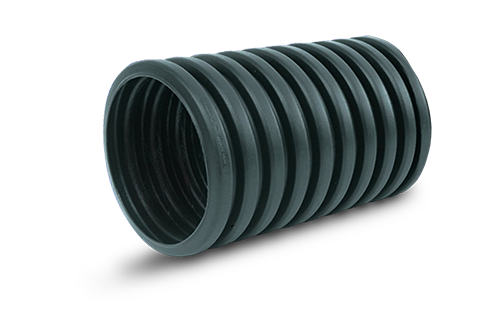
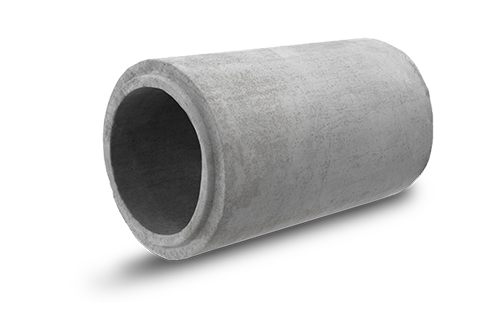

Many consider precast concrete as representing the standard for large-diameter gravity sewer and stormwater applications. RCP creates a rigid pipe system that provides both structural integrity and conveyance capacity. The material is particularly well-suited for applications requiring high structural loads, deep burial depths, and long-term durability.
The primary advantages of RCP include exceptional structural strength, superior abrasion resistance, and proven longevity in harsh environments. RCP maintains its structural shape under heavy loads without requiring critical backfill conditions, which reduces installation complexity and liability for both engineers and contractors. The material’s inherent fire resistance and ability to withstand temperature extremes make it ideal for industrial applications and areas prone to wildfires.
RCP installation follows established protocols that emphasize proper bedding and joint sealing. The installation begins with excavation to the specified grade, followed by preparation of a stable, uniform bedding material, typically granular material or lean concrete. Each pipe section is carefully lowered into position using appropriate lifting equipment, with particular attention to joint alignment and pitch.
The rigid nature of RCP requires precise grade control during installation, as the pipe cannot flex to accommodate minor grade variations. Joints are typically sealed using rubber gaskets, mastic, or MacWrap Couplers depending on the specific application requirements. Backfill operations must follow manufacturer specifications to ensure proper load distribution, though RCP is more forgiving than flexible pipes regarding backfill compaction requirements.
RCP typically represents the highest initial material cost among the three primary pipe materials. Installation costs can be 50% to 100% higher than alternative, lighter-weight pipe susbstrates, particularly in smaller diameter applications. However, this initial investment is often justified by the material’s extended service life and reduced maintenance requirements. The total lifecycle cost of RCP frequently proves competitive when factoring in longevity and reduced replacement frequency.
Modern RCP systems are designed for service lives exceeding 100 years under normal operating conditions. The material’s inherent durability and resistance to chemicals contribute to this exceptional longevity. Properly installed RCP infrastructure from the early 1900’s continue to provide reliable service, demonstrating the material’s long-term viability.
RCP failures typically result from sulfuric acid attack in sewer applications, particularly in areas with high hydrogen sulfide generation. This biological corrosion process called Microbial-Induced Corrosion (or MIC), attacks the concrete matrix, leading to rapid structural deterioration. Other failure modes include joint infiltration due to improper sealing, external corrosion in acidic soil enviroments, and structural cracking from excessive loading or poor installation practices. However, modern protective coatings and corrosion-resistant concrete mixes can significantly reduce these failure modes.
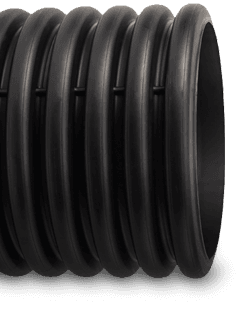
HDPE (polyethylene) & HDPP (polypropylene) pipe has gained significant market acceptance due to its molecular structure which provides excellent resistance to chemical attack, making it particularly suitable for industrial applications and areas with aggressive soil conditions. HDPE’s flexibility allows it to accommodate ground movement and thermal expansion without joint failure, a major advantage in seismically active areas.
The lightweight nature of HDPE significantly reduces handling and installation costs, while the smooth interior of its double-wall style pipe surface provides excellent hydraulic characteristics and resistance to biological growth. HDPE’s resistance to freeze-thaw cycles and its ability to expand and contract without cracking can make it ideal for cold climate applications.
HDPE installation is generally faster and less labor-intensive than other substrates due to the material’s lightweight and flexible nature. Trenches can often be narrower, and the pipe’s flexibility allows for minor grade adjustments during installation. HDPE pipe sections are typically joined using heat fusion techniques, snap couplers, or PolySeal Couplers, creating continuous, leak-proof joints that are often stronger than the pipe itself.
The flexible nature of HDPE requires proper bedding and backfill procedures to prevent excessive deflection. Unlike rigid pipes, HDPE relies on proper side support to maintain its structural integrity. Installation procedures must ensure adequate compaction of backfill materials to provide the necessary soil-structure interaction.
HDPE typically offers cost advantages over RCP, particularly in smaller diameter applications. The material cost is generally lower, and installation savings result from reduced equipment requirements, faster installation times, and lower labor costs. Transportation costs are also reduced due to the material’s lightweight properties and longer available pipe lengths.
HDPE pipe systems are designed for service lives of 50 to 100 years, depending on operating conditions and installation quality. The material’s resistance to chemical attack and environmental stress cracking contributes to this longevity. However, HDPE is susceptible to degradation from UV light, though this is only a concern for above-ground applications.
HDPE failures most commonly result from third-party damage during construction activities, as the material’s flexibility can mask damage that may not become apparent until system pressurization. Excessive deflection due to inadequate side support can lead to reduced capacity and potential failure. While HDPE is highly resistant to chemical attack, certain organic solvents and hydrocarbons can cause swelling or degradation. Installation defects, particularly inadequate fusion joint procedures, can also lead to premature failure.

Corrugated steel pipe, aka Corrugated Metal Pipe (CMP), is an attractive option for culvert and stormwater applications providing exceptional structural efficiency, allowing CSP to carry significant loads while using relatively thin wall sections. The material’s strength-to-weight ratio is excellent, and its ability to flex under load provides good performance in unstable soil conditions.
CSP is readily available in large diameters and can be field-assembled for very large applications. The material’s conductivity provides freeze protection in cold climates, and its structural properties make it suitable for shallow cover applications where other materials might require special design considerations.
CSP installation is relatively straightforward, with the material’s light weight facilitating handling and placement. The corrugated structure requires proper bedding to ensure uniform load distribution across the pipe invert. Unlike rigid pipes, CSP develops its structural capacity through soil-structure interaction, making proper backfill procedures critical to performance.
Joint connections are typically bolted, sealed with o-rings, flat band gaskets, or CSP Couplers, allowing for field assembly and easier handling of large-diameter sections. The installation process must ensure proper alignment and joint tightness to prevent infiltration, maintain hydraulic performance and structural integrity.
CSP generally provides the lowest initial cost option among the three materials, particularly in large-diameter applications. Installation costs are typically lower due to lighter weight and simpler handling requirements. However, in corrosive environments, lifecycle costs may be higher due to a shorter service life and potential maintenance requirements.
CSP service life can vary significantly based on environmental conditions, with typical design lives ranging from 25 to 75 years. In non-corrosive environments with proper protective coatings such as factory polymer-coated or PSC 9450 treated pipe, CSP can provide many decades of reliable service.
Corrosion represents the primary failure mode for untreated CSP, particularly in acidic soils, high chloride environments, or sewer applications where hydrogen sulfide is present. The thin wall sections used in CSP make the material particularly vulnerable to perforation once corrosion initiates. Abrasion from debris-laden flows can also accelerate wear in stormwater applications. Modern protective coatings and galvanizing significantly improve corrosion resistance, but routine inspection and maintenance are encouraged for optimal performance.
RCP is particularly well-suited for large-diameter detention and retention systems due to its structural integrity and ability to handle deep burial depths. The material’s resistance to freeze-thaw cycles makes it ideal for underground storage systems that may experience varying water levels throughout the year.
HDPE pipe is increasingly used in modular retention systems and infiltration galleries, where its flexibility allows for innovative designs that can accommodate ground movement. The material’s smooth interior surface maximizes storage capacity while its chemical resistance makes it suitable for treating runoff from industrial areas.
CSP serves effectively in detention pond outlets and emergency spillway applications, where its cost-effectiveness and structural performance provide excellent value. The material’s ability to be field-assembled makes it particularly useful for large-diameter overflow structures.
RCP culverts excel in high-traffic roadway crossings and railroad applications where structural strength is paramount. The material’s fire resistance makes it particularly valuable in wildfire-prone areas where other substrates might be vulnerable.
HDPE culverts are increasingly specified for stream crossings and environmentally sensitive areas due to their smooth interior surface, which reduces hydraulic resistance and provides better fish passage characteristics. The material’s flexibility accommodates ground movement and frost heave, making it ideal for challenging soil conditions.
CSP remains the material of choice for many highway and agricultural culvert applications, particularly where cost considerations are primary and soil conditions are not highly corrosive. The material’s strength-to-weight ratio allows for efficient installation in remote locations with limited equipment access.
RCP is preferred for high-temperature applications, chemical processing facility drainage, and installations requiring exceptional abrasion resistance. HDPE excels in chemical plant drainage, landfill leachate collection systems, and marine applications where salt water exposure is a concern. CSP finds use in mining operations, agricultural drainage, and temporary installations where cost-effectiveness and ease of installation are priorities.
The decision should consider local availability, contractor experience, and long-term maintenance capabilities. Each material has proven successful in appropriate applications, and the key to optimal performance lies in matching substrate characteristics to the project requirements while ensuring proper installation practices.
Regardless of which pipe material is selected for your project, ensuring reliable, long-lasting connections is critical to system performance and longevity. MarMac® is the industry leader in innovative sealing solutions that address the unique challenges of connecting different pipe materials and creating permanent, infiltration-proof joints.
MarMac® MacWrap Couplers are a highly-advanced, external joint coupler designed to permanently prevent infiltration at precast concrete structure connections, including reinforced concrete pipe (RCP), manhole sections, box culverts & stormwater retention systems. These couplers represent the gold standard for RCP connections, providing superior sealing performance that exceeds traditional joint methods.
MacWrap Couplers utilize advanced materials and engineering to create permanent seals that accommodate minor ground movement while maintaining exfiltration-resistant integrity throughout the structure’s service life. The external application method allows for quality control verification and provides access for future inspection if required.
MarMac® PolySeal Couplers are a high performance, external joint coupler designed for the prevention of infiltration and resistance of exfiltration at joints of common HDPE & HDPP corrugated pipe. These specialized couplers address the unique challenges of connecting flexible pipe materials while maintaining the hydraulic advantages of smooth-wall systems.
PolySeal Couplers feature multiple integrated compression bands that conform to the corrugated profile of HDPE pipe, creating multiple sealing points that provide redundant protection against infiltration. This design approach is particularly valuable in applications where groundwater levels may fluctuate or where external pressure conditions vary.
MarMac® CSP Couplers represent a breakthrough in corrugated steel pipe connection technology. This single unit, external sealing band is designed to prevent infiltration into corrugated steel pipe drainage systems, creating a strong, permanent, flexible seal around the joints of rerolled (annularized) or non-rerolled (spiral) CSP pipe ends.
The CSP Coupler addresses the unique challenges associated with corrugated steel pipe connections, where traditional coupling methods often fail to provide adequate long-term sealing performance. These couplers are over-engineered to be the finest couplings available – they’re easy to install, highly-durable, resistant to failure, and impressively far exceed NCSPA‘s watertight, hydrostatic requirement.
For the CMP industry, our Watertight CSP Coupler eliminates infiltration & exfiltration on both rerolled and non-rerolled ends of corrugated steel pipe joints, providing water-tight performance when used on Seam Sealed pipe. This comprehensive sealing approach ensures that CSP systems can deliver the performance and longevity that infrastructure projects demand, while maintaining the cost-effectiveness that makes corrugated steel pipe attractive for many applications.
One of our most innovative solutions addresses the common challenge of connecting different pipe materials within the same system. MarMac® Dissimilar Pipe Couplers (DP Couplers) are engineered to join, seal, and restrain the connections between pipes of differing material and/or pipes of varying nominal size.
These versatile couplers eliminate the need for costly transition structures or complex adapter systems when connecting RCP to HDPE, CSP to RCP, HDPE to CSP, or any other combination of pipe materials. With hundreds of designs to cover virtually any scenario, MarMac® DP couplers provide engineers with the flexibility to optimize material selection for each portion of a system without compromising connection integrity.
Our commitment to quality and innovation has resulted in pipe couplers that outlast the pipe materials they connect. Our external sealing approach provides several advantages over traditional internal sealing methods, including easier installation, better quality control, and the ability to accommodate pipes that may be slightly out of round or damaged during handling.
The investment in premium MarMac® couplings represent a small fraction of total project cost while providing significant long-term value through reduced maintenance, eliminated infiltration problems, and extended system life. For engineers and contractors seeking to maximize the performance and longevity of their pipe systems, MarMac®’s proven sealing solutions offer the reliability and peace of mind that infrastructure projects demand.