
Concrete Coating
PSC 2306
The Lasting Barrier Against Sewer Degradation
One-part (1K) polymeric protective coating that shields concrete from water, acid & chemical intrusion in destructive sewer environments.
1K System
Single-Part Coating
25 year
Manufacturer Warranty
24/7
Long-Term Protection
Just 1 Coat
Needed for Most Applications1
Up to 500 ft2
Coverage Per Container1
5.68 GALLON
Container Size
Corrosion Protection
Delays the start of MIC by decades.
Rigorously Tested
Across multiple performance categories.
Superior Adhesion
Stronger than concrete = No delamination.
Environmentally Friendly
Effective, safer coal tar epoxy replacement.
THE PROBLEM
Acidic wastewater & microbes are corroding your city sewers
Corrosive chemical runoff from pesticides & fertilizers, polluted groundwater infiltration, acid-secreting bacteria (MIC) – municipal sanitary sewer & stormwater systems face harsh conditions every day. Unprotected, concrete sewer infrastructure rapidly corrodes and deteriorates, leading to costly replacements. Sewer systems that engineers plan to last for 50-70 years often reach structural failure in as few as 25.
WHY PSC 2306
Four reasons engineers specify it
Lasting adhesion
While competing products struggle with delamination, PSC 2306 has been tested to several internationally-recognized adhesion standards including ASTM D7234 where it "consistently exceeds the break strength of the substrate", meaning the coating outlasts the surface it protects.
Lower long-term cost
PSC 2306 extends structural serviceable life by fighting corrosion from day one. The impermeable barrier prevents absorption of water, acid, and chemicals into the concrete –delaying stage 1 of Microbial-Induced Corrosion decades, resulting in less frequent costly repairs or replacements.
Impermeable surface barrier
PSC 2306's dense polysiloxane matrix is moisture-activated, cross-linking with both itself and the concrete it protects. The result is a highly hydrophobic barrier that repels water, chemicals, and acids – preventing contact with the concrete surface.
Single-component application
Many competing products are two-part systems, requiring mixing in the field and resulting in added delays. PSC 2306 is a one-part (1K) formula — no field mixing required. Simply open, stir, and apply with an airless sprayer, brush, or masonry roller.
HOW TO USE
Simple to apply
1
Thoroughly brush and/or pressure wash the substrate to remove dirt, laitance, curing compounds, grease, and efflorescence. Surface must be structurally sound and free of contaminants. Test moisture per ASTM D4263.
2
Stir thoroughly to ensure uniform tint. Do not introduce air or dilute. PSC 2306 is moisture-activated; recommended structure moisture content is 3.5%–5%, though it has applied successfully at over 25% in laboratory conditions.
3
Apply via airless sprayer, 1/4–3/8" masonry nap roller, or medium-stiff brush between 60–122°F. Use a wet film thickness gauge and apply at 16 mil per coat. A second 16 mil coat may be applied at tack-off (~15 min). Do not exceed two coats.
4
Touch dry in 12 hours. Tack-free at 48 hours. Full cure in 7 days at 74°F. Protect coated surfaces from traffic, impact, and chemical exposure until fully cured. Dry film thickness is approximately 9 mils per coat.
Coverage
🛡️ STANDARD PROTECTION
1 coat
~ 500 ft2
🛡️🛡️ HEAVY-DUTY PROTECTION
2 coats
~ 250 ft2
CURING
Two coats (@ 16 mil WFT each) is the manufacturer’s recommendation. Actual coverage rates and curing times may vary depending on substrate porosity, surface texture, application method, and weather conditions. Let us know if tinting is required for treated structures within your municipality and/or project.
Safety & PPE
When spraying
Do Not inhale aerosols
Good room ventilation
Wear N95 respirator
Independent
Rigorous testing


Chemical & Acid Resistance
Treated & untreated samples were soaked in extreme pH solutions — incl. sulfuric, nitric, hydrochloric, and acetic acids; ammonium hydroxide, and caustic potash — for 90 days at 20% higher concentrations than required, with monthly solution recharges to retain potency.
Pull-Off Adhesion to Concrete
Pull-off adhesion testing was conducted on cementitious substrates incl. concrete block and cast pours, per ASTM D7234 procedures, to quantify the bond strength of PSC 2306 to concrete in direct tension.
Cross-Cut Adhesion
Adhesion was evaluated on four construction substrates — calcium silicate brick, fibre cement, concrete, and previously coated façade paint — using the cross-cut (grid cut) method with a multi-blade tool forming a 25-square grid.
Freeze-Thaw Resistance
Brick specimens treated at 100 g/m² and 200 g/m² were subjected to 15 complete freeze-thaw cycles in a 3% sodium chloride solution, cycling between +20°C and −20°C. Mass loss was measured every 5 cycles.
Wet Abrasion Resistance
The coating was applied at two dry film thicknesses (6 mil and 10 mil) and subjected to 200 wet scrub cycles with a standardized detergent solution. Mean layer thickness loss was measured after testing.
Surface Hardness
Surface hardness was measured by König pendulum damping method on a 200 µm dry film at standard climate conditions (23°C / 50% RH). Three measurements were taken per specimen for statistical reliability.
Applications
Where to use
- Sanitary Sewer Systems
- Stormwater Sewer Systems
- Manholes
- Concrete Pipe (RCP)
- Box Culverts
- Any Precast Concrete Structure
Typical Properties
Technical specifications
Ready to spec PSC 2306?
Our specifications engineers are ready to work with you to get PSC 2306 specified for approval for your municipality or job.
Want more information? Fill out the form and our team will get right back to you, or request a Lunch & Learn for your team – no strings attached!
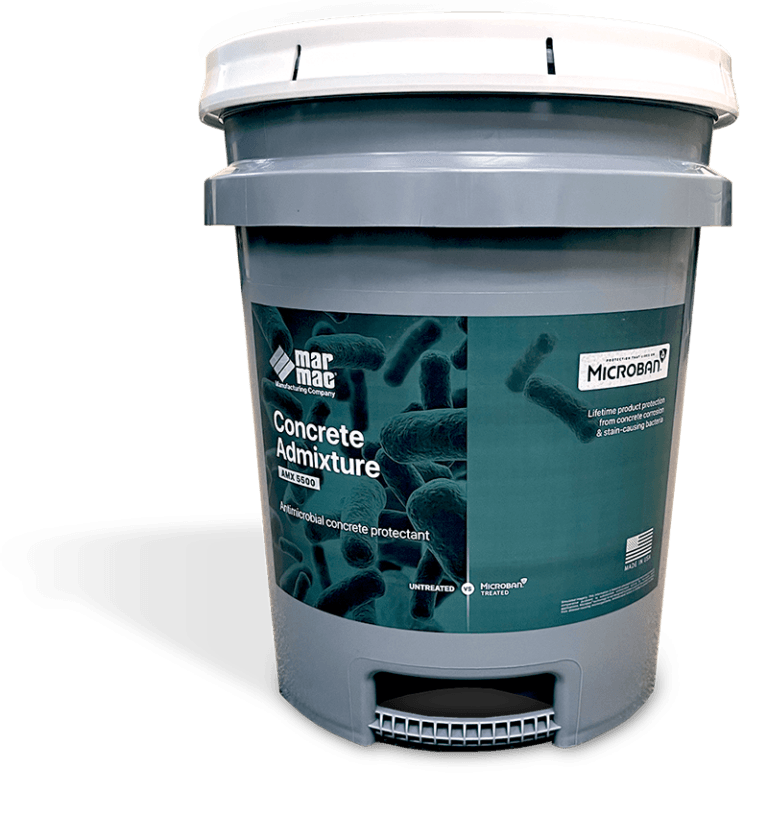
COMPLETE PROTECTION SYSTEM
Include AMX 5500 for total corrosion defense
PSC 2306 seals the surface — and when paired with our Microban®-powered Concrete Admixture AMX 5500, you get a complete, layered protection system that fights corrosion from both inside and outside the concrete matrix. The result: treated sewer systems reaching 90+ year serviceable life in corrosion-prone environments.
PSC 2306 blocks the acid. AMX 5500 continuously reduces the bacteria producing it. Together, they beat concrete corrosion at every stage.